
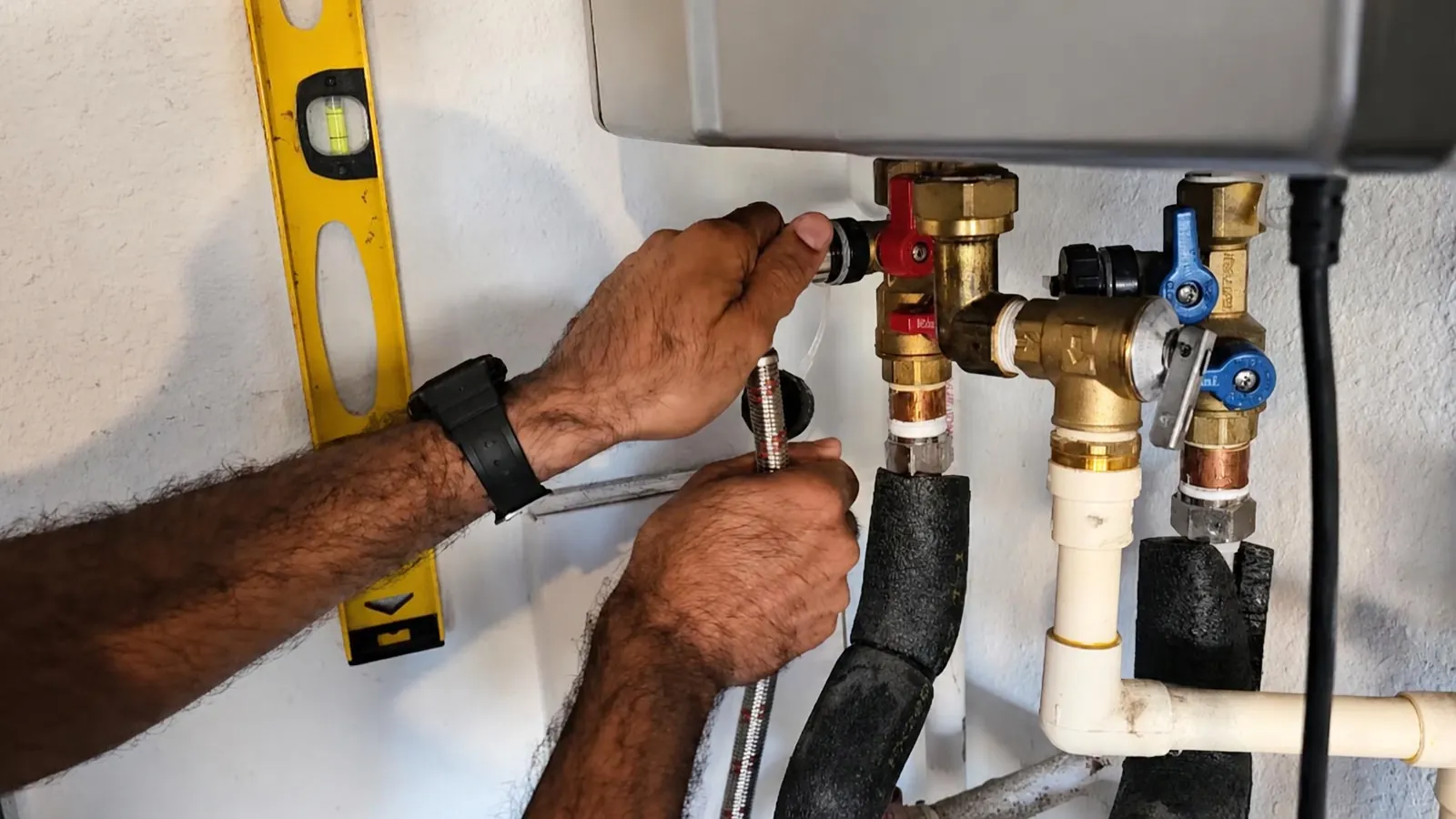
Why a gas tankless install is a bigger job than a tank swap
A tank holds forty or fifty gallons of preheated water and fires its burner at a modest rate. A tankless unit heats water as it flows, so the burner has to ramp up hard the moment a tap opens. Many whole-house gas models are rated well above what a standard tank draws, often by a factor of three or four.
That higher draw ripples outward. The gas meter, the pipe feeding the heater and the vent all have to handle the load, and any one of them can be the item that turns a simple swap into a modification. Ask your plumber to read the nameplate rating and compare it with the pipe that is already there.
What changes the price of a gas tankless install
These are the factors that move the total up or down, listed from the ones that usually matter most.
Gas line capacity
If the existing pipe is too small for the unit's rating, a longer or larger run is needed from the meter. Distance and routing through finished walls change the labor.
Venting type and route
Condensing models vent through plastic pipe out a side wall, while non-condensing ones need stainless venting. A long run, a roof exit or a tight chase adds materials and hours.
Condensate drain
Condensing units produce acidic water that must be drained, sometimes through a neutralizer. A nearby floor drain or laundry standpipe is easier than a pump.
Water-side parts
Isolation valves for flushing, a relief valve with a discharge line, and possibly an expansion tank are all part of a proper setup, and the number of fittings depends on the room.
Removal and location
Taking out a tank, relocating the heater or mounting on a different wall changes both the labor and the pipe needed.
Homeowners insurance typically covers sudden and accidental damage, not the cost of upgrading a working or worn-out heater. If a failed tank flooded the room, the water damage may be a claim while the new heater itself usually is not, so read your policy or ask the insurer.
For the real number on your own house, call (410) 378-7601 and describe the room, the fuel and the vent route.
What happens on an install day
Every job varies, but gas tankless installs generally follow this order.
- Survey and load checkThe plumber reads the unit's rating, inspects the gas line, and decides where the vent will exit.
- Shutoff and removalGas and water are closed, the old heater is drained, disconnected and carried out.
- Mount and pipeThe new unit goes on the wall, with gas, cold supply, hot outlet, relief valve and condensate piping connected.
- Vent and testVent sections are joined and sealed, then the gas joints are leak-tested before the burner is lit.
- CommissioningThe unit is fired, the temperature is set, and flow is checked at the farthest fixture.
Savings math: what a tankless heater can and cannot do
A tankless heater does not keep forty gallons hot around the clock, so it skips the standby heat loss that a tank pays every hour. Households with moderate use often see a lower gas bill. A house with several showers running at once may find the unit reaches its flow limit, since each model can only heat so many gallons per minute to a given temperature.
Lifespan is another argument. Tankless units are generally expected to last longer than tanks, but they need periodic descaling, particularly where the water carries minerals. The town's water report gives no hardness figure, so test your own tap or ask the Water Department before you plan a maintenance schedule.
Read the tankless water heater service page if you want to compare gas models, and think about whether your hot water demand justifies the extra upfront work.
Questions that get you a price you can compare
When you collect more than one price, ask each plumber the same things.
- What is the unit's maximum gas input, and does the existing line carry it?
- Where will the vent exit, and what material is it?
- How will condensate drain, and is a neutralizer included?
- Are isolation valves, a relief valve discharge line and an expansion tank part of the price?
- Is the removal of the old heater included?
- Is the price clear before work starts, and what could change it once the wall is opened?
Gas work and the question of licensing
Gas piping and venting mistakes are not cosmetic. A poor joint leaks gas and a poor vent can push exhaust back into the house. If you ever smell gas, leave the building, call 911 and then call the gas utility, and do not flip a switch on the way out.
Where the install ties into other work, such as new piping or a relocated utility room, new plumbing installation work may be part of the same visit. For the unit itself, a full water heater installation covers mounting, connections and testing as one job.
Middletown, DE: the code and license behind the install
Delaware's plumbing regulation, 16 Del. Admin. Code 4455, adopts the 2021 International Plumbing Code with state amendments. Those amendments address water heater piping, relief valves and expansion tanks, so ask your installer which of those parts your setup needs and why.
Delaware also requires a Delaware license to do plumbing work, even for someone licensed in another state. The Board of Plumbing, Heating, Ventilation, Air Conditioning and Refrigeration Examiners, under the Division of Professional Regulation, issues Master Plumber licenses. Before you sign, check the plumber at delpros.delaware.gov using the Verify License Online tool. It takes a minute and settles who is allowed to do the work.
Source type: Delaware Administrative Code, Division of Professional Regulation FAQ.
Questions Middletown homeowners ask
Why does a gas tankless install cost more than a tank replacement?
The unit is usually pricier, and the surrounding work is heavier. Larger gas pipe, specialized venting and a condensate drain are common additions that a like-for-like tank swap does not need.
Do I need a bigger gas line for a tankless heater?
Often, yes, though not always. Check the unit's maximum input against the capacity of the line from the meter. A plumber sizes the pipe by the input rating and the length of the run.
Can a tankless heater use my existing vent?
Rarely. Tank flues and tankless vents differ in material, diameter and temperature rating, so most installs need a new vent path.
How can I check that a plumber is licensed in Delaware?
Use the Verify License Online tool at delpros.delaware.gov, run by the Division of Professional Regulation. A Delaware license is required for plumbing work even if the plumber holds one in another state.
Does a tankless heater work during a power outage?
Most gas tankless units need electricity for the controls and fan, so they stop without power. A battery backup is available for some models.
Can you install a gas tankless heater in Townsend too?
Yes, we dispatch licensed plumbers to Townsend as well as Middletown. Call and describe the house, and we will line up an appointment, same day when available.
The short version
Gas capacity, venting, condensate and code parts are the four drivers behind any gas tankless total. Get each answered in writing and the quotes become comparable.
We dispatch licensed Delaware plumbers to Middletown and to nearby Townsend, and the full list sits on the service area page. Call (410) 378-7601 to talk through your house and get a clear price before work starts.
Standards and sources
The state amendments to the 2021 IPC in 16 Del. Admin. Code 4455 cover water heater piping and relief valves, which a gas tankless install must satisfy.