
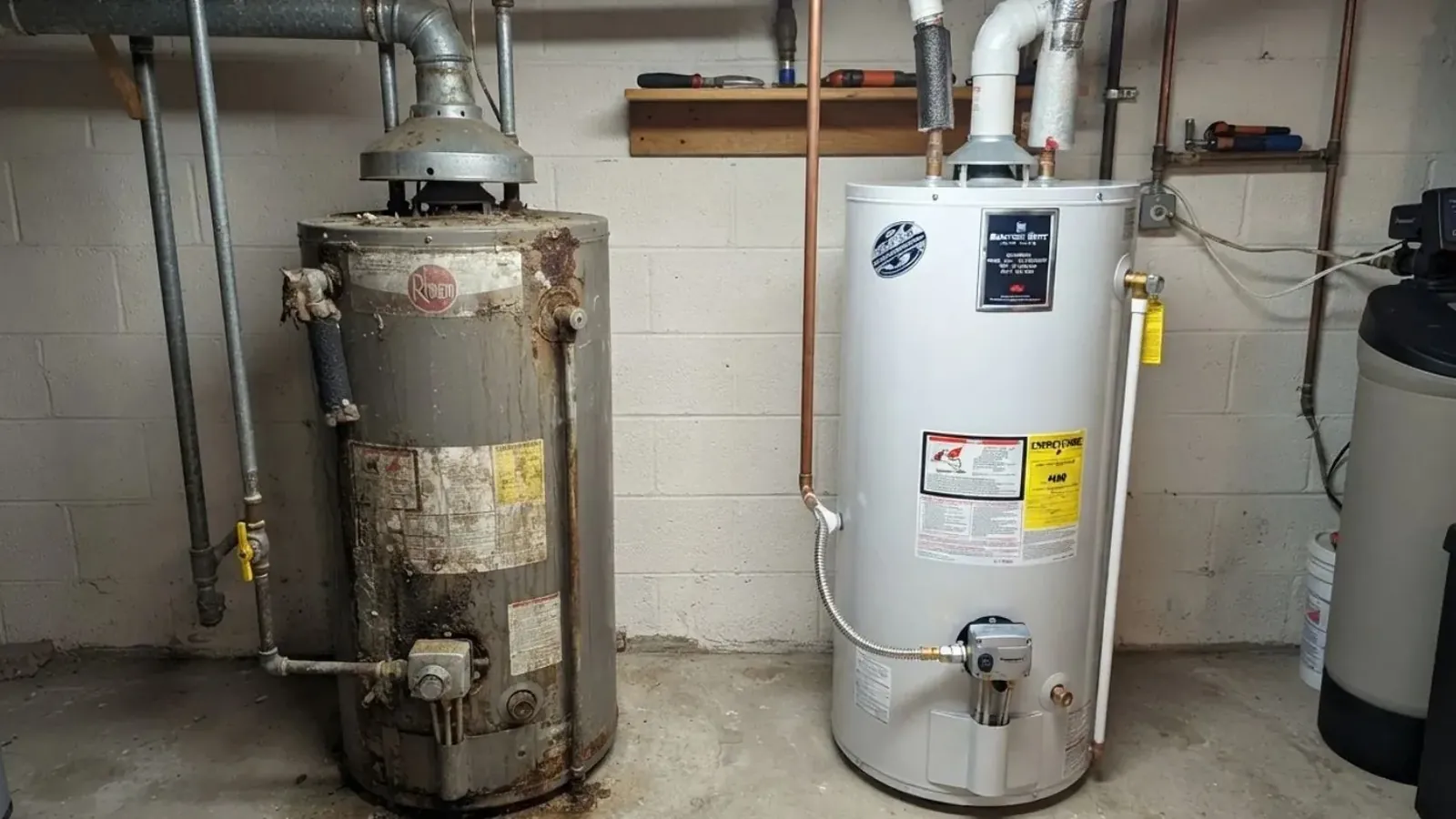
If the tank is leaking tonight
A leaking tank does not stop on its own, and the lining that failed will not heal. Even a slow weep can soak a subfloor over a night. Our line stays open all night and on weekends, and a plumber can be booked for the same day when slots are open.
What to do while you wait
- Find the cold water valve on the pipe entering the tank and turn it clockwise until it stops.
- Electric heater: turn off its breaker at the panel. Do this only if the floor around the panel is dry.
- Gas heater: set the gas control knob to off, and leave the building at once if you smell gas.
- Open one hot water faucet upstairs to let pressure out of the system, then leave it open.
- Place towels and a bucket under any dripping point and photograph the tank, the water and the rating plate.
Why a leaking tank ends the repair question
A tank heater is a steel vessel with a glass-like lining that keeps water from the metal. Sediment, heat cycles and time wear that lining thin. When it cracks, the steel underneath rusts through, usually near the bottom seam, and the tank starts to weep.
That is why a leak from the tank body is different from a leak at a fitting. A valve, connector or drain can be swapped and the heater runs on. A rusted shell cannot be patched in any way that holds under pressure and heat. A leaking tank means replacement, and a plumber's job is to confirm the water is coming from the tank itself before saying so.
To check yourself, dry the floor and jacket, then watch for fresh drips. If they trace to pipes or the relief valve, a repair visit for a leaking fitting may be enough.
Repair or replace: a decision table
These situations come up most often, with the leaning most plumbers would give you.
| Situation | Usually better | Why |
|---|---|---|
| Water seeping from the tank body or seam. | Replace. | The inner shell has failed and cannot be sealed. |
| Heater near or past ten years, one part failing. | Lean replace. | Another part is likely to follow, and the tank itself is aging. |
| Newer tank with a bad element or thermostat. | Repair. | The tank is sound and the part is easy to swap. |
| Relief valve drips on a younger tank. | Repair. | The valve or system pressure is the problem, not the shell. |
| Rumbling and rusty hot water on an older tank. | Lean replace. | Heavy sediment and corrosion point to a worn-out tank. |
| Household has grown and hot water runs out. | Replace or add. | A bigger tank or a different type suits the new demand. |
Ask the plumber to say the reason out loud, so you know if the bill is for a part or a whole unit.
Reading the date code on the rating plate
Age is the first number a plumber wants, and the rating plate holds it. The plate is a sticker or metal tag on the side of the tank.
- Find the plateLook for a label on the upper side of the tank listing the model, capacity and serial number. Photograph it with your phone.
- Locate the serial numberIt is a string of letters and digits, often beginning with a letter. On many brands the first letter stands for the month and the next two digits for the year.
- Decode it for your brandBrands code their serial numbers differently, so check the manufacturer's decoder chart or ask the plumber to read it.
- Compare with the ten-year markMany tank heaters need replacement somewhere around ten years. A heater well past that is borrowing time, even if it works today.
Sizing a tank for your household
Bigger is not always better. An oversized tank wastes energy keeping extra water warm, and an undersized one runs out in the middle of a shower.
| Household | Typical tank | What to watch |
|---|---|---|
| One or two people. | 30 to 40 gallons. | Shorter showers rarely push a small tank past its limit. |
| Three or four people. | 40 to 50 gallons. | Back-to-back showers and a dishwasher run are the stress test. |
| Five or more people. | 50 to 80 gallons. | Check the first-hour rating on the plate as well as the capacity. |
| Large soaking tub or multiple baths. | Higher first-hour rating. | A tub alone can draw most of a 50 gallon tank. |
The plumber measures the space too, since a taller tank may not clear the ceiling or the closet door.
Standard, high-efficiency and heat pump units
A standard tank is the lowest-cost option to buy and works the way water heaters have for decades. A high-efficiency gas or electric tank uses extra insulation, better burners or condensing technology to cut running costs, and it can ask more of the venting. A heat pump unit moves heat from the air into the tank and uses much less electricity, but it needs open space around it and a drain for condensate.
Incentives and rebates come and go, so check current offers yourself rather than assuming any exist. For what the new unit needs once it is chosen, see how a proper install is done.
Tankless as the alternative to another tank
A tankless heater warms water as it flows, so there is no tank to leak or run out. That also means no standby loss. The trade is installation: tankless units often need larger gas lines, different venting or heavier electrical circuits than the tank they replace. If you are considering one, read about the tankless water heater option to see whether your house and habits fit before the old tank is gone.
Middletown homes from the 2000s are reaching heater age
The town grew from 6,161 residents in 2000 to 18,871 in 2010, and much of the housing is from that wave. If your home dates from then, the original water heater is now somewhere around its second decade, well past the typical lifespan. Look at the plate this week, not the week it fails.
Before the swap, ask the town permits office at 302-378-1171 what your job needs. Permit rules vary, so do not assume. The town publishes a Plumbing Permit Application, and a licensed plumber can tell you which part of it applies. In Delaware, any plumbing work requires a Delaware license, and you can verify one at delpros.delaware.gov.
Replacing gas with a heat pump heater, and flood calls
Switching from gas to a heat pump unit changes more than the tank. The gas line is capped, the flue may be removed or redirected, and the new unit needs an electrical circuit and room to breathe. It is a project to plan, not to rush during an emergency.
If a flood forces your hand, a quick same-day swap with the same fuel type gets hot water back, and the larger conversion can follow later. A plumber can tell you what the layout allows. Homes in Townsend, about 7 miles south, are covered by the same line, as described on the Townsend plumbing page.
What changes the price of a water heater replacement
The unit is only part of the number. These factors move the final price, and a plumber states it clearly before work starts.
Tank size and type
A 50 gallon high-efficiency unit costs more than a 30 gallon standard one, and a heat pump unit costs more again.
Fuel and conversion work
Keeping the same fuel is simpler. Changing fuel adds gas line, venting or electrical work.
Condition of the old connections
Corroded shutoff valves, brittle supply lines or a missing expansion tank get replaced while the tank is out.
Location and access
A heater in an attic or tight crawl space takes more labor to remove and carry out.
Permits and inspections
If the town requires a permit for your job, that adds a step. Ask the permits office what it asks for.
Insurers usually treat sudden and accidental damage, such as a burst tank flooding a finished basement, differently from wear and tear. A heater that simply reached the end of its life is typically not covered, but the water damage it caused may be. Read your policy or ask your insurer.
Call (410) 378-7601 and tell the dispatcher the tank size, fuel and age, and we will give you the pricing before anyone starts.
Water Heater Replacement: Common Questions
Do you handle water heater replacement emergencies at night or on weekends in Middletown?
Yes. Our emergency line is open 24/7, and a leaking tank at midnight is a normal call. We dispatch a licensed plumber and book same-day appointments when available. While you wait, close the cold valve above the tank and cut the power or gas.
How long does a tank water heater last?
Many tank heaters need replacement somewhere around the ten-year mark. Lifespan depends on water quality, sediment and how well the tank was maintained. Read the date on the rating plate to see where yours stands.
Can I switch from a gas water heater to a heat pump unit?
Yes, in many homes, though it is a bigger job than a like-for-like swap. The gas line is capped, the venting is changed or removed, and the new unit needs electricity and open space around it. A plumber can check your layout first.
What do I do if the water heater floods or needs replacing at night?
Shut the cold supply valve, switch off the breaker or gas control, and keep clear of standing water near outlets. Then call the 24/7 line. The plumber can confirm the leak is the tank and plan the swap.
Do I need a permit to replace my water heater?
Permit rules vary, so ask the town permits office at 302-378-1171. The town publishes a Plumbing Permit Application, but its page does not say which jobs need one. A licensed plumber can help you ask the right question.
How do I check that the plumber is licensed?
Delaware requires a Delaware license for plumbing work, and you can verify one through the state's Verify License Online tool at delpros.delaware.gov. We dispatch licensed Delaware plumbers.
What happens to the old tank?
The plumber drains it, disconnects it and carries it out. Ask when you book that disposal is part of the visit, so you are not left with a 100 pound steel tank in the garage.
Ready to talk through your options? Call (410) 378-7601 anytime.
Standards and sources
Under 16 Del. Admin. Code 4455, Delaware adopts the 2021 International Plumbing Code (IPC) with amendments covering water heater piping, relief valves and expansion tanks. Ask the plumber how a replacement will meet those amendments, and ask the town permits office what the job needs.