
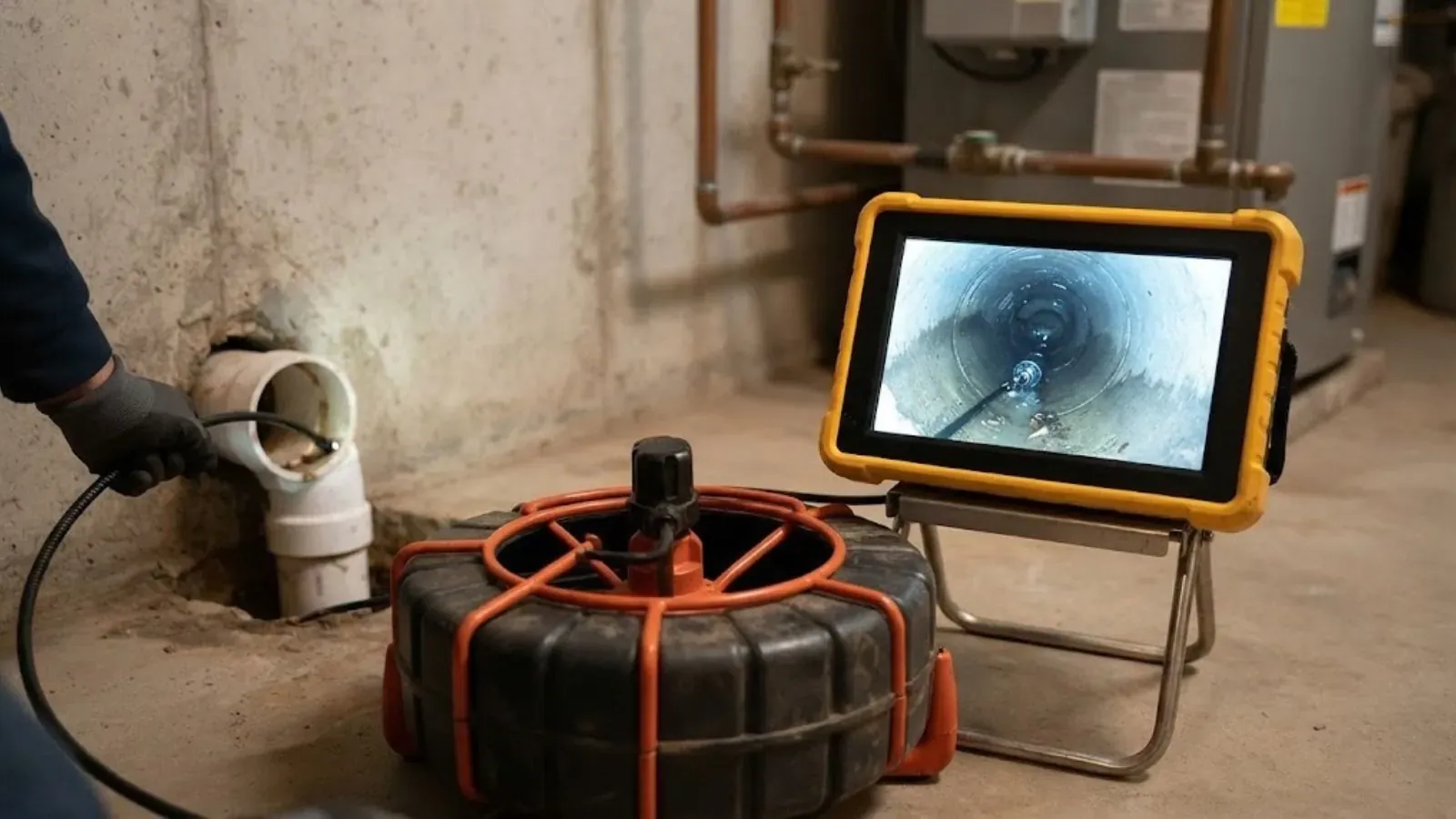
What the camera shows inside the pipe
The camera head is about the size of a golf ball or smaller, with LED lights and a lens that looks forward. It rides on a push rod, often 100 feet long or more, and sends live video to a monitor. A footage counter shows how far in the camera is, so every feature gets a distance.
On a sound pipe you see a smooth, round, evenly colored wall. Trouble shows up as roots entering at a joint, a crack running along the pipe, a joint that has shifted so one section sits lower than the next, a coating of grease, or standing water along a stretch where the pipe sags. Some plumbers record the run, so you can show it to a buyer, a landlord or a repair contractor.
The picture is the evidence. It lets you compare a plumber's description to what is on the screen, which matters before agreeing to a repair or when two opinions disagree.
How a camera inspection runs
The visit follows a simple order.
- Find the way inThe plumber uses a cleanout if there is one. Without it, access may come through a toilet flange or a roof vent.
- Run the camera toward the streetThe head moves down the lateral at walking pace while the plumber watches for defects and notes the distance of each one.
- Mark what mattersA problem spot is noted with its depth and distance, and the plumber can often pinpoint it from above ground.
- Review the footage with youYou see what the plumber saw, and you learn which findings are cosmetic, which will need cleaning and which need repair.
How locating a problem from above ground works
The camera rod or the head carries a small transmitter. A plumber walks the yard with a receiver, which picks up the signal and shows both the position and a depth reading, so the spot can be marked with paint or a flag. A defect found at 62 feet becomes a mark on the lawn, not a guess.
That mark matters if the answer is digging to repair a sewer line. Depth decides whether the fix is a short trench or a bigger excavation, and the location tells you what sits above it, such as a driveway, a tree or a fence.
Do not dig on the strength of a paint mark alone. Call 811, the Miss Utility line, at least 48 hours before any digging, so gas, electric and other buried lines are marked first. A sewer locate shows the sewer and nothing else.
Buying, renting out or re-cleaning: what the inspection answers
Each situation has a different question, and a different limit on the answer.
| Situation | What the inspection answers | Limit to keep in mind |
|---|---|---|
| Buying a house. | Whether roots, cracks or a belly are visible in the lateral before closing. | It shows today's condition, not how long the pipe will last. |
| Renting out a property. | Whether the line has defects a tenant will hit as repeat clogs. | It does not replace town paperwork for occupancy. |
| Line clogged twice or more. | Why the clog returns: roots, grease, a low spot or a break. | A full pipe blocks the view until it is cleaned. |
| Sewer smell near a drain or yard. | Whether a crack or open joint is leaking. | A camera shows the interior, so a leak in a dry crack can still be subtle. |
| After a cleaning. | Whether the pipe wall is clean and sound. | It cannot predict future root growth. |
Buying a home or renting one out
A house inspection usually checks the roof, the furnace and the visible plumbing, but the buried lateral stays out of sight. A camera run before closing shows whether the line carries a defect that you would otherwise inherit. If the footage shows roots or a break, you can ask the seller about it while there is still room to negotiate.
Owners who rent or lease a home without living in it must have it inspected by the town before it is occupied. Ask the Middletown permits office, Permits, Licensing and Inspections at 302-378-1171, what that inspection covers. Repairs that follow a camera finding may also involve plumbing permit paperwork, and permit rules vary, so ask the town before work starts.
Keep the footage with the property file, and see plumbing help in Townsend if the property sits there, since sewer service in Townsend runs through New Castle County Special Services. A landlord who can show a clean line at the start of a tenancy has a clear reference if a backup is blamed on the building later.
A pipe that clogs again and again
A line that clogs once might have swallowed a toy. A line that clogs three times in a year has a cause that cleaning alone is not removing. The camera finds it: a root at the third joint, a grease shelf along the bottom, or a spot where the pipe dips and water stays.
Each finding leads to a different path. Roots and grease can be handled with hydro jetting that scours the pipe wall, plus a schedule for repeating it. A belly or a break points toward repair. Knowing which one you have keeps you from paying for a cleaning that will not hold.
Plumbers often scope a line right after cleaning, when the pipe is clear and the picture is sharp.
Honest limits of a camera
A camera cannot see through a full pipe. If the line is backed up with water or packed with debris, the lens sees a wall of liquid or a blockage, not the pipe. That is why clearing the sewer line may need to come first, and why a plumber may recommend cleaning before the inspection even though the aim was a look.
A camera also cannot see outside the pipe. It shows the interior wall, not the soil around it or a void under the line. Where the town sewer main ends and your lateral begins is a question for the Middletown Water Department at 302-378-2211, since the camera cannot tell you whose pipe it is looking at.
What changes the price of a sewer inspection
Inspection is a planned job, so the price can be set before the plumber starts.
Access to the line
A cleanout makes the visit simple. A toilet pull or roof vent entry takes longer.
Length of the lateral
More footage means more rod, more time and a larger area to locate.
Cleaning first
A line that is partly blocked must be cleared before the camera sees anything, which adds a task.
Locating and marking
Finding a defect from above ground with a receiver is additional work beyond the video run.
Recording and report
A saved video and notes take more effort than a quick look, and they are useful for a purchase or a repair bid.
Homeowners insurance generally does not cover a planned inspection, and it pays for damage only when the cause was sudden and accidental, not wear. Read the policy or ask your insurer if a covered event started the problem.
Call (410) 378-7601 to schedule a camera inspection, and ask for a clear price before work starts.
Sewer Camera Inspection: Common Questions
How long is the camera line, and can it reach the street?
Camera rods are often 100 feet or longer, which covers many house laterals. Access, bends and the pipe condition all affect how far it travels.
Can a sewer camera find a leak?
It can find visible cracks, open joints and root intrusion that point to a leak. It cannot show water moving into soil outside the pipe, so a plumber combines it with other signs.
Do I need an inspection if my drains work fine?
Not for daily use. It makes sense before buying a home, after repeated clogs, or when roots are a concern. A working drain does not prove the pipe is sound.
Will I get a recording of the inspection?
Many plumbers save the video. Ask when you schedule, and ask for the distance marks of any findings so you can find them later.
What if the camera cannot get all the way through?
It stops for a reason: a blockage, a bend, a break or a collapsed section. The plumber notes the distance and the likely cause, and cleaning or repair is the next step.
Does the town need to see my sewer inspection report?
This page cannot say, because the town does not list that rule. Ask the town permits office at 302-378-1171 whether a rental inspection or a permitted repair needs your footage.
To schedule a camera look at your sewer line, call (410) 378-7601 and tell the dispatcher why you want it.
Standards and sources
A camera inspection records what is in the pipe, and any repair that follows falls under Delaware's plumbing regulation (16 Del. Admin. Code 4455, which adopts the 2021 IPC with state amendments). Call 811 at least 48 hours before any digging that follows.