
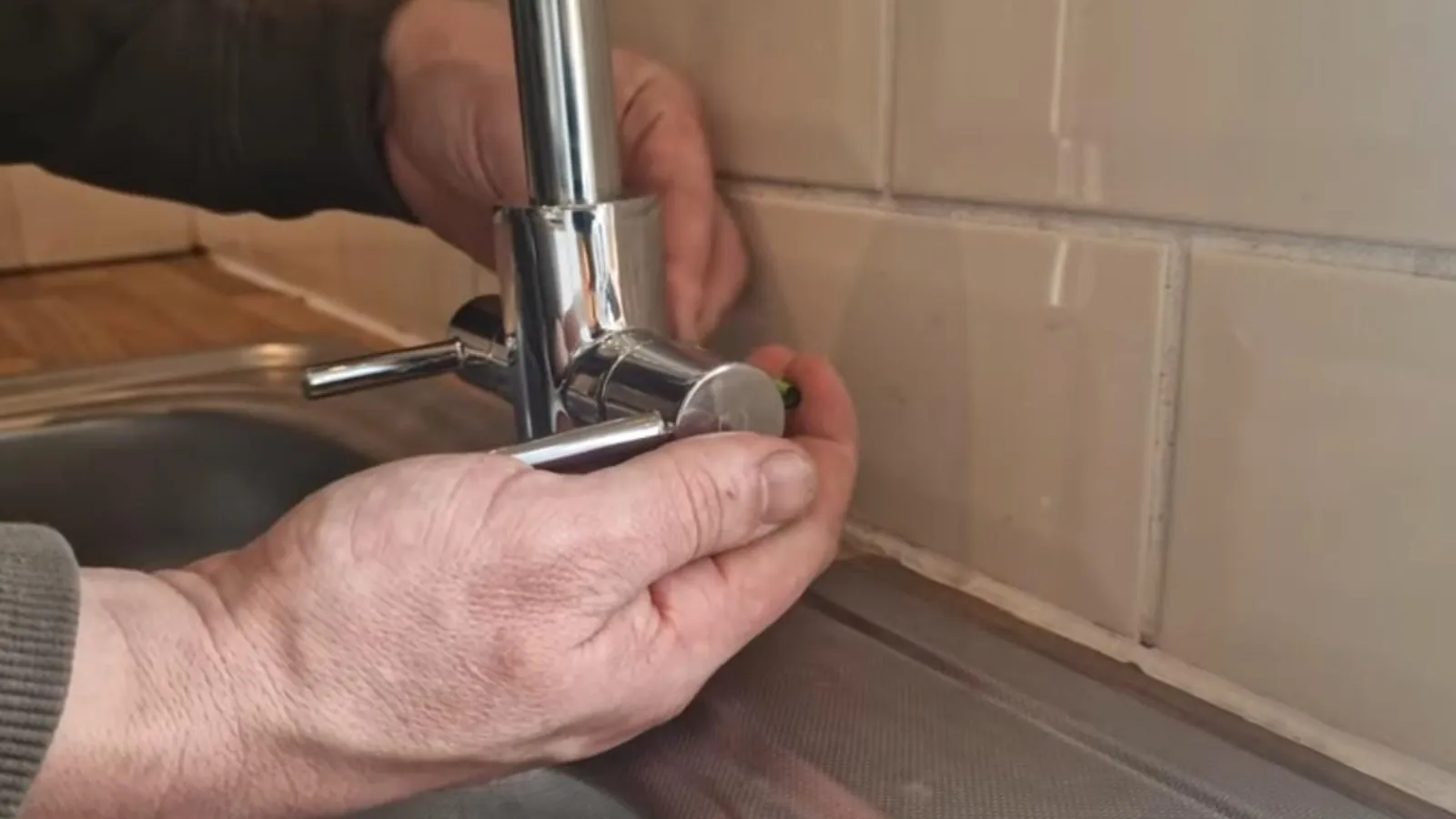
A faucet or valve leak that cannot wait
A supply valve spraying under a sink, a faucet that will not stop running, or a leak soaking the cabinet floor is an emergency. The 24/7 emergency line is open at night and on weekends, so a cabinet filling at midnight does not have to wait for morning.
A slow drip at the spout is a nuisance by comparison and can usually take a same-day appointment when available. If the fixture will not shut off and the valve beneath it is stuck or broken, the answer is the house main. Know where it is before you need it.
What to do while you wait
- Turn the shutoff under the sink clockwise to close it. If the handle spins freely or will not move, go straight to the main.
- Close the main water valve where the service line enters the house, then open the lowest tap to relieve pressure.
- Switch off power to outlets and appliances near standing water, and stay out of the room if a panel is wet.
- Empty the cabinet and lay towels around its base so the particleboard is not left soaking.
- Photograph the fixture, the valve and any water damage for an insurer or landlord.
Five faucet complaints and what usually causes them
A drip from the spout usually means a worn seal. In a washer faucet it is the rubber washer or the brass seat under it, and in a cartridge faucet it is the cartridge or its O-rings. Tightening the handle harder rarely stops it and can chew up the seat.
A handle that spins without changing the flow has lost its grip on the stem. The cause is often a stripped set screw or a cracked adapter, and the fix is usually small hardware or a new cartridge.
Low flow at one faucet is commonly a clogged aerator or a half-closed shutoff. Low flow at every tap points elsewhere, so call the Middletown Water Department at 302-378-2211 and ask whether the town side has a problem before you blame the house.
Water under the sink can come from the supply line, the shutoff, the faucet base or the drain. Dry everything, wrap a dry tissue around each joint, and watch which one darkens first. A leak at the disposal flange looks similar and belongs to garbage disposal repair.
Four faucet designs and how each one fails
Knowing the design tells you whether the repair is a small washer or a whole cartridge.
| Design | How it controls water | How it usually fails |
|---|---|---|
| Compression. | Screws a rubber washer down onto a brass seat, with separate hot and cold handles. | The washer hardens or the seat pits, so the spout drips. |
| Cartridge. | A sliding or rotating stem inside one handle mixes hot and cold. | O-rings wear and the cartridge sticks, which leaks at the handle or limits hot water. |
| Ball. | A slotted ball under a single lever lines up with hot and cold ports. | Rubber seats and springs weaken, causing drips at the spout or around the base. |
| Ceramic disc. | Two polished discs slide against each other inside a sealed cylinder. | Wear is slow, but grit or scale cracks the seals and the whole cylinder is replaced. |
Swapping the cartridge or cylinder is often the entire repair. A photo of the faucet and any brand name stamped on it helps match the part.
What to shut off first, in order
The sequence matters because the first valve you reach may be the one that has failed.
- Close the fixture valveTurn the small oval or round handle under the sink clockwise. Each faucet has one for hot and one for cold.
- Check that flow stopsOpen the faucet. If water still runs after a few seconds, that valve is not sealing.
- Go to the mainClose the main shutoff, then open a low tap so the lines drain and pressure falls.
- Plug the drainSet a rag or the stopper in the sink so a dropped screw or part cannot disappear.
- Call with what you sawSay which valve failed to close and what the faucet does. That tells the plumber which parts to bring.
Repair or replace: how a plumber weighs it
Repair makes sense when the faucet body is sound and the failing part is a cartridge, disc, washer or O-ring. Replace makes sense when the body is pitted or corroded, when parts for that model are hard to find, or when the same faucet has failed twice.
Age matters too. Faucets commonly last somewhere in the range of 15 to 20 years, and much of Middletown's housing comes from the 2000s growth wave, so fixtures installed then are probably reaching replacement age. Ask the plumber whether a cartridge swap will buy you years or only months.
A shutoff valve that will not close
Old multi-turn shutoffs seize when mineral scale builds on the stem or the washer inside crumbles. A quarter-turn ball valve can also stick if it has not been moved in years. Forcing either one risks snapping the stem and starting a leak you cannot stop without the main.
A stuck shutoff means replacing the valve itself, not the faucet. The plumber closes the main, cuts out the old valve, and fits a new quarter-turn stop on the pipe, then checks the other valves under that sink. A drip around the stem often just needs the packing nut snugged, which a plumber can test gently before replacing anything.
If a dry cabinet floor still gets wet and you cannot trace it, a moisture reading and pressure test finds the wet joint without taking the wall apart.
A burst or broken supply valve
A handle that snaps off in your hand, a stem that blows out under pressure, or a corroded body that weeps at every joint is a failed supply valve, and it can flood a cabinet fast. The same goes for the shutoff behind a toilet, which is covered on the toilet repair page.
Close the main immediately. The repair is a new valve on the pipe, usually a quarter-turn type, with a fresh braided supply line if the old one is stiff or crusted. Because valves of one age tend to fail together, it is smart to test every shutoff in the house once the first one is replaced.
Showers, tubs and tub drains
A showerhead that drips after the handle is off usually has a worn washer or a failing cartridge behind the wall. A drip from the head alone can be as simple as a loose connection or scale in the head. A leak inside the wall at the valve body shows as a stain on the room behind it and needs a plumber to open the access.
A tub faucet that runs warm when off or leaks at the spout follows the same logic: a cartridge or seat has worn. Tub spouts with a diverter for the shower can also leak from the diverter alone.
A shower or tub drain that clogs and returns is usually a hair and soap mat in the first foot or two of the trap, a pipe about 1.5 inches wide. Pulling it by hand fixes many cases, and chemical cleaners are best avoided because they sit in the pipe and can attack fittings.
Checks you can run before you call
- Unscrew the aerator and look for grit or white scale that blocks flow.
- Dry the cabinet and note which joint wets first.
- Try both shutoff valves and note which one fails to close.
- Photograph the faucet, the brand marking and the spot where it leaks.
- Check whether the drip is hot, cold or both, since that points to one side of the mechanism.
- Note whether the problem appears at one fixture or every one in the house.
Flush the line after plumbing work
After any plumbing work, run the cold tap for 30 seconds to 2 minutes before you drink from it. The town advises flushing a tap that has sat for several hours before drinking or cooking, and the same habit clears loose grit from a fresh repair. Remove the aerator and rinse it too, so debris does not clog the new faucet.
What changes the price of faucet repair
A drip and a flooding valve are both faucet calls, but the work behind them is very different.
Faucet design and brand
Some cartridges are common parts, while others are made for one model and must be ordered.
Repair or full replacement
A cartridge swap and a new fixture involve different parts and different time at the sink.
Condition of the shutoff valves
If the valves under the sink will not close, they are replaced first, which adds work.
Access
A pedestal sink, a wall-mounted fixture or a shower valve inside a wall takes more effort than a standard kitchen sink.
After-hours call
A midnight emergency call involves different scheduling than a same-day appointment when available.
Insurers usually treat sudden damage from a failed valve differently from long-term seepage, and a worn washer on its own is maintenance, not a claim. Read your policy or ask the insurer, and keep photos of any water damage.
You will hear a clear price before work starts, so call (410) 378-7601 and describe the faucet or valve.
Faucet Repair: Common Questions
Do you handle faucet repair emergencies at night or on weekends in Middletown?
Yes. The 24/7 emergency line takes calls about faucets and valves that will not shut off, burst supply lines and flooding cabinets at any hour.
Close the valve under the fixture or the main, and call. Slower drips can be booked as a same-day appointment when available.
Does a dripping faucet raise my water bill?
Yes, though the amount depends on the drip rate.
A drop every second adds up to roughly a gallon a day with typical drop sizes, and a faster stream costs more. Fixing it is also easier on the fixture than letting scale build.
What does a cartridge replacement involve?
A cartridge replacement swaps the internal part that controls flow and temperature while the faucet body stays in place.
The plumber shuts off the water, removes the handle and retaining clip, pulls the old cartridge, and fits a matching one with new O-rings. Matching the exact part is the main skill.
Do you repair outdoor spigots?
Yes, a plumber can repair or replace an outdoor spigot, also called a hose bib.
Water expands about 9 percent when it freezes, so disconnect hoses before the first hard frost. A spigot that drips inside the wall after winter may have a split that needs replacement.
Do I need a new supply line with a new faucet?
Usually yes, because the old braided line is stiff and its fittings may not match.
A stiff old line can split without warning and flood the cabinet. The plumber checks the shutoff at the same time.
Is it safe to keep using a faucet that drips?
Usually yes, as long as the drip is small and the cabinet below stays dry.
A faucet that will not shut off, a handle that spins free or any water under the sink should be treated as urgent.
Do you handle faucet repair in Townsend?
Yes, the same dispatch line covers Townsend, about 7 miles south on DE-71.
See the Townsend plumber page for the local details.
If a faucet or valve will not shut off, call (410) 378-7601 and tell us which one it is.
Standards and sources
Fixture work is covered by Delaware's plumbing regulation (16 Del. Admin. Code 4455, based on the 2021 IPC), and Delaware requires a state license for plumbing work. You can verify a license at delpros.delaware.gov. After the work, the town advises flushing a tap for 30 seconds to 2 minutes before drinking.