
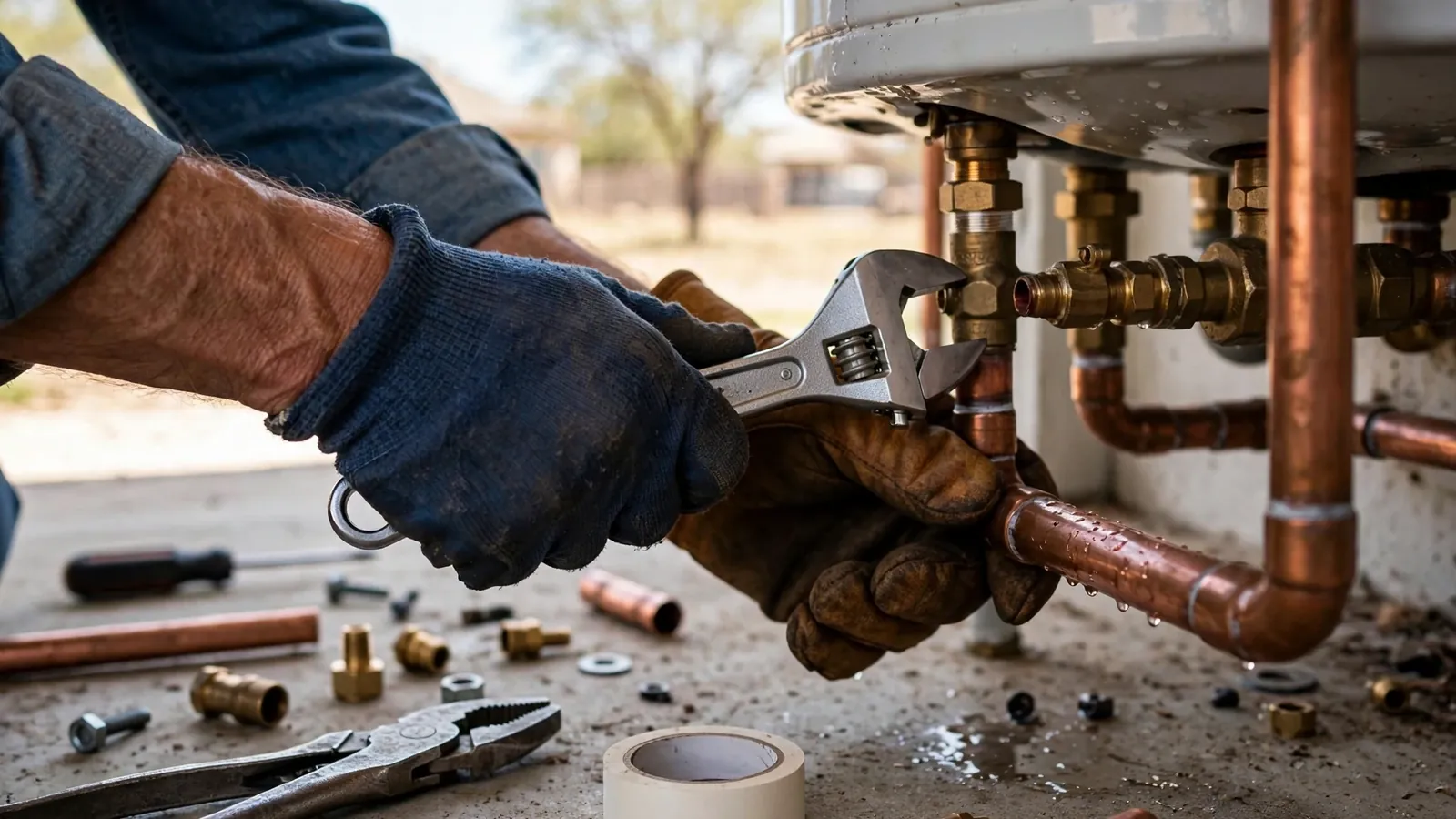
Shut it down in this order
Do these before you start looking for the source.
- Turn off the powerSwitch the unit off at its control, then unplug it or flip its breaker. Water and electricity share a wall here.
- Close the gasTurn the gas valve handle a quarter turn so it sits crosswise to the pipe. If you smell gas, leave the building and call 911.
- Close the cold supplyShut the isolation valve on the cold inlet. If there is none, use the main shutoff for the house.
- Drain the standing waterOpen a hot tap upstairs to relieve pressure, then catch what remains with a pan or towels.
- Photograph everythingTake photos of the unit, the data plate and the wet area before you wipe anything.
Where the water comes from
Match what you see to the likely source before anyone starts unscrewing parts.
| What you see | Likely cause | Repair or replace |
|---|---|---|
| Drips at a pipe connection on the bottom. | Loose or worn fitting, failed union washer. | Usually a repair. |
| Weeping at an isolation or service valve. | Worn valve packing or a damaged seat. | Usually a repair, valve replacement. |
| Steady dripping from the relief valve line. | High pressure, temperature trouble or a failing valve. | Needs diagnosis, as the valve is a safety device. |
| Water from the condensate drain or trap area. | Blocked or frozen condensate line, overflowing trap. | Often a cleaning or neutralizer fix. |
| Water inside the cabinet that returns after a repair. | Cracked heat exchanger. | Often a replacement of the unit. |
| Water on the floor from the vent pipe. | Condensation running back, or a vent slope problem. | Needs correction at the vent. |
Why scale causes leaks
Minerals deposit inside a tankless heat exchanger the longer the unit runs. The scale narrows passages, raises the temperature of the metal and can lead to hot spots, cracked joints or failed seals. A unit that has never been flushed is a likelier candidate for a leak at age eight than one that has.
If your unit has isolation valves, a flush with a descaling solution is a task the maker's manual describes. If it does not, ask a plumber to add them. Once a heat exchanger has actually cracked, flushing cannot undo it.
What to write down before you call
A short note saves time on the phone and helps a claim.
- The brand, model and install year from the data plate on the unit.
- Whether the leak is steady, intermittent or only when hot water runs.
- Whether an error code shows on the display.
- Photos of the leak, the wall and the floor around the unit.
- Whether the home has a water softener or a filter upstream.
- Whether the unit was recently flushed or serviced.
When the leak is a repair and when it is the end of the unit
Fittings, valves and condensate lines cost little compared with a new unit, and they are where most leaks start. A cracked heat exchanger is different. It often costs about as much to replace as a new heater, and a second cracked part tends to follow.
If the unit is past the age most makers describe as typical service life and the leak is internal, replacing it is usually sounder than repairing it. A visit also tells you whether water seen at the wall comes from the unit or from a pipe behind it. In that case, leak detection help finds the source without opening more wall than needed.
Cost factors and your insurance
What the repair costs depends on the part that failed, the unit's age and model, whether isolation valves exist, and whether the surrounding drywall or flooring got wet. A condensate fix and a heat exchanger swap sit at opposite ends. The plumber states a clear price before work starts, once the source is known.
Home insurance generally covers sudden, accidental water damage but not the worn part itself. Your photos and a plumber's note on the cause are the documents to hand to the insurer.
Do not run the unit while it leaks
It can be tempting to use the heater until help comes. A leak onto a control board or a vent connection can short the unit and, with gas appliances, cause a safety problem. Leave it off, use the shutoffs, and wait for the appointment.
If water is spraying or the floor is flooding, treat it as an emergency. Call the 24/7 line and meanwhile keep people and pets away from wet electrical areas.
Middletown, DE: two water sources, two answers on scale
The town pumps groundwater from the Upper Potomac and Magothy aquifers through three wells between 374 and 838 feet deep, and also takes purchased water from Artesian Water Company through interconnections. Willow Grove Mill, Parkside and Estates at Dove Run buy water from Artesian Water Company, which draws on 67 wells in New Castle County. Which source feeds your address is a question for the Middletown Water Department at 302-378-2211.
The town report gives no hardness figure, so do not assume one. Test your tap with a kit, ask the Water Department what applies to your address, and set the flushing schedule on your heater from that answer.
Source type: town 2025 water quality report.
Questions Middletown homeowners ask
Why is my tankless water heater leaking from the bottom?
Fittings, valves and condensate lines are the common sources at the bottom of the unit. Turn off power, gas and water, then trace the wet spot to a connection. A drip that returns after tightening can mean a cracked heat exchanger.
Is a leaking tankless heater dangerous?
It can be. Water near electrical parts and gas connections is a risk. Shut off power, gas and the cold supply, and leave the unit off until it is checked.
Can I flush a leaking unit to fix it?
Flushing clears scale but cannot seal a crack or replace a worn fitting. Fix the leak source first, then flush on the maker's schedule.
Does my insurance cover a leaking water heater?
Sudden and accidental water damage may be covered, while a worn part usually is not. Read your policy or ask the insurer, and keep photos and the plumber's note.
Which water supplies Middletown homes?
The town draws groundwater from three wells and also buys water from Artesian Water Company, and three named systems buy from Artesian directly. Call 302-378-2211 to ask which applies to your address. See the Townsend plumbing page if you are in Townsend, where Artesian Water is listed for water service.
The short version
A wet tankless heater has a short list of causes, and turning off power, gas and water in order keeps a small leak small. Photos, the data plate and a clear description of the drip let the plumber arrive with the right parts.
For a leak at the heater, call (410) 378-7601, day or night. The service area page shows the towns we dispatch to.
Standards and sources
State amendments to the 2021 IPC in 16 Del. Admin. Code 4455 address water heater piping and relief valves.