
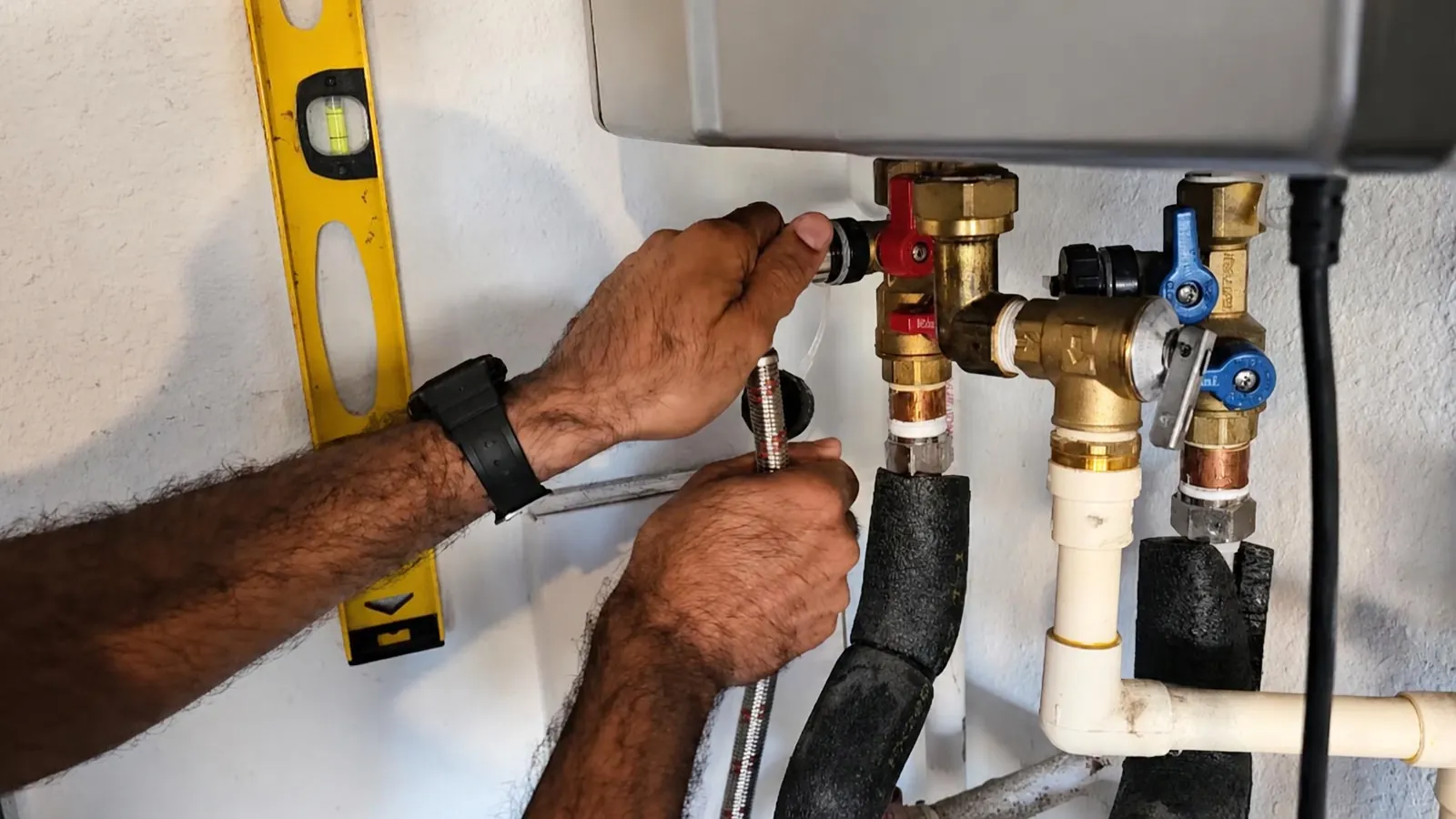
Two machines, two jobs
A tankless unit heats water only while a fixture is open. Cold water enters, a burner or electric element heats it as it passes through a heat exchanger, and the stream leaves at the set temperature, commonly around 120 degrees F. When the faucet closes, the heating stops, so there is no tank of stored water losing heat overnight.
A boiler is a closed loop. It heats water that circulates through radiators, baseboard fin tubes or in-floor tubing and then returns to be heated again. That water never reaches your faucets, and it is not the water you drink. A boiler by itself provides heat, not showers.
Some houses add an indirect tank, a small insulated cylinder that borrows heat from the boiler loop. Others install a combination boiler, which has a second heat exchanger for domestic water. Knowing which of these you already own is the first question on any visit.
Which setup answers which problem
Match your situation to a row before talking about brands or sizes.
| Your situation | Option | Trade-off |
|---|---|---|
| Tank heater is old and hot water runs out, but the boiler works. | Standalone tankless unit. | Endless hot water at one flow rate, but gas line size and venting must support it. |
| Boiler is failing and the tank heater is fine. | Replace only the boiler. | Heat returns, the hot water side stays untouched, and nothing changes in the bathrooms. |
| Both are aging and basement space is tight. | Combination boiler. | One wall-hung unit does heat and hot water, but a single failure leaves you without both. |
| Boiler is fine and you want to drop the tank. | Indirect tank on the boiler. | Uses the existing burner, though the boiler must be sized to carry both loads. |
| Several bathrooms run at once. | Tankless sized for peak flow, or two units. | Flow rate and temperature rise decide the size, not the number of bedrooms. |
Each row changes what the plumber has to measure, which is why a quick phone guess rarely holds up.
Flow rate and temperature rise decide the size
Tankless units are rated by how many gallons per minute they can raise by a certain number of degrees. A shower head often uses around 2 gallons per minute, a kitchen faucet about 1.5, and a washing machine more. Add up what could run at the same time, then look at how cold the incoming water gets in winter.
If the ground-fed supply arrives at 50 degrees F and you want 120, the unit must add 70 degrees at full flow. A model that handles that at 5 gallons per minute may only manage a smaller rise when the water is colder. Undersized units show up as lukewarm showers when someone starts the dishwasher.
This is why the plumber counts fixtures and checks the incoming temperature instead of choosing by house square footage.
What gets checked before a swap
A site visit for a tankless or boiler change covers these points, in roughly this order.
- Gas line size and length. Tankless burners draw a lot of fuel at once, and a line sized for a tank heater can be too small.
- Venting path. Condensing units use plastic vent pipe, and the run to the exterior wall has length and elbow limits set by the maker.
- Condensate drain. High-efficiency units create acidic condensate that needs a safe place to drain, often with a neutralizer.
- Electrical supply. Even a gas tankless needs a nearby outlet for the fan and controls.
- Pipe sizing and shutoffs. Isolation valves make flushing possible later, so they should be part of the install.
- Water supply test. Mineral content affects scale, so test your tap or ask the Water Department before you pick a maintenance schedule.
Scale, flushing and what shortens a unit's life
Tankless heat exchangers have narrow passages, and mineral scale narrows them further. Many makers call for an annual flush with a descaling solution, which is easier when isolation valves are installed. A unit left alone for years can lose output or trip error codes on its own.
Tank heaters commonly need replacement around the ten-year mark, while tankless units are often described as lasting longer when maintained. A water heater repair visit is worth requesting if you see lukewarm output, rumbling, error codes or water at the unit before deciding to replace anything.
Why the swap is more than a like-for-like trade
Going from a 40-gallon tank to a wall unit moves the gas line, the vent and sometimes the water piping. That makes the labor and parts different from a tank change, even when the same fuel is used. A water heater installation on this scale starts with measurements, not a model number.
Ask for a clear price before work starts, and ask the plumber to explain anything that does not match what you already have in the basement.
Middletown, DE: gas utilities and the state plumbing code
Delaware adopts the 2021 International Plumbing Code with state amendments, and those amendments address water heater piping, relief valves and expansion tanks. That means a new heater's relief valve and expansion tank are not afterthoughts. Ask the installer to point out both on the finished job.
Gas service is another place where your address matters. Townsend's resident information page lists Delmarva Power and Chesapeake Utilities as gas utilities, and which one serves a given house depends on the street, so check your own bill before calling. If you ever smell gas, leave the building, call 911, and then call your gas utility.
Source type: Delaware Administrative Code, Townsend town website.
Questions Middletown homeowners ask
Can a tankless water heater heat my house?
No, not on its own. A tankless unit is built for domestic hot water at taps and showers. Heating radiators or baseboards takes a boiler or a combination unit built for that loop.
What is a combination boiler?
A combination boiler is one wall-hung appliance that heats the radiator loop and also heats water for the faucets on demand. It saves floor space, but when it fails both services stop. Many homeowners prefer separate systems for that reason.
Does a tankless unit need a bigger gas line?
Often it does, because the burner uses a large amount of fuel at once. The plumber measures the existing line length and size before recommending a model. Sometimes the answer is a new, larger branch off the meter.
Is a boiler the same as a hot water heater?
No. A boiler heats water for the heating system and keeps it in a closed loop. A water heater heats the water that comes out of your taps.
Which gas utility serves Townsend homes?
Townsend's resident information page lists Delmarva Power and Chesapeake Utilities as gas utilities, and the one serving you depends on your address. Your gas bill names your provider. For work in that town, see the Townsend plumbing page.
The short version
Pick the machine that matches the job: a tankless unit for taps, a boiler for radiators, a combination unit only when space or age pushes both together. The deciding facts are gas, venting and flow rate, which the plumber has to measure in your basement.
To talk through your setup, call (410) 378-7601. Our service area covers Middletown and Townsend, and same-day appointments are offered when available.
Standards and sources
Delaware's amendments to the 2021 IPC (16 Del. Admin. Code 4455) cover water heater piping and relief valves.