
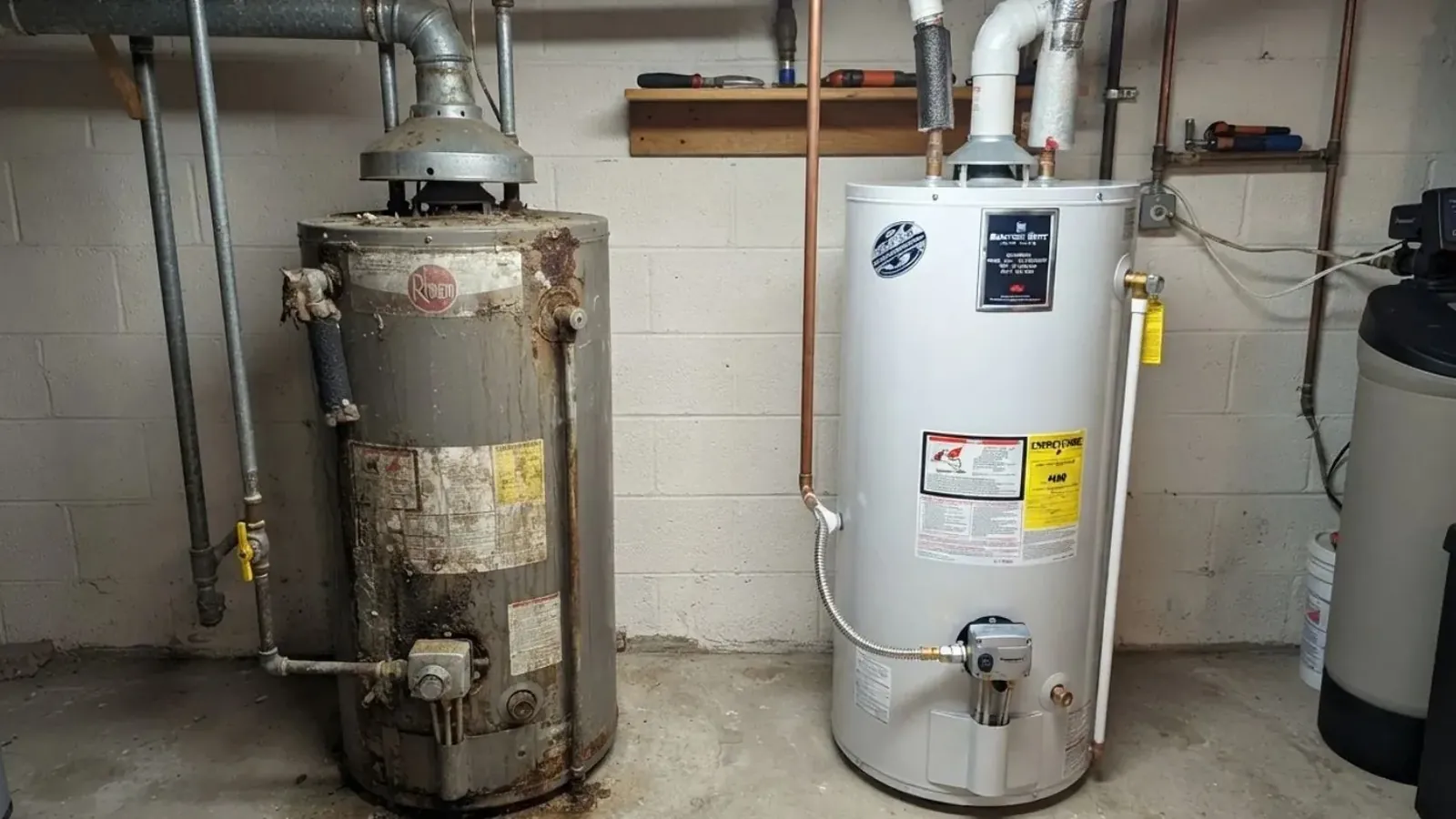
The ten-year mark and why it matters
Many tank heaters need replacement somewhere around the ten-year mark, and some fail sooner. Inside every steel tank, a sacrificial anode rod corrodes in place of the tank wall. Once the rod is spent, the shell starts to rust, and the failure usually arrives as a slow seep that turns into a flood.
The label on the side of the unit carries a serial number that encodes the manufacture date. Plumbers can read it in seconds, and it is the quickest way to learn how much life is realistically left. A heater that is eight years old and working fine is a candidate for planning. One that is thirteen and has just developed a drip is a candidate for replacement this week.
Repair, watch or replace: reading the symptoms
Each symptom below has a different likely cause, and only some of them end the life of the heater.
| Symptom | Likely cause | Usual decision |
|---|---|---|
| Water pooling at the base. | Rusted tank shell, or a loose fitting above it. | Check the fittings first. If the tank is the source, replace the heater. |
| Rumbling or popping while heating. | Sediment baked onto the bottom of the tank. | A flush may help on a younger unit. On an older tank it signals aging. |
| Lukewarm water that runs out fast. | Failed heating element or thermostat on an electric unit, or a dip tube problem. | Repair is often reasonable if the tank is sound and under about eight years old. |
| Rusty or brown hot water only. | Corroding tank interior, since cold water stays clear. | Replace soon, especially on an older heater. |
| Pilot will not stay lit on a gas unit. | Failed thermocouple or a gas control fault. | Repair on a young tank, and weigh replacement on an old one. |
Leaks: which ones you can fix and which you cannot
Not every wet spot at the heater is a dead tank. A weeping drain valve, a loose supply line or a dripping relief valve can all put water on the floor, and each is an inexpensive part. Dry the area, check each connection with a paper towel, and watch for fresh moisture over an hour.
If the water seems to come from under the insulation jacket or from the bottom seam, the tank has failed. At that stage a water heater repair visit is only worth it to confirm the diagnosis and shut things down safely. Turn off the cold supply valve above the unit, switch off the power or set a gas unit to pilot, and attach a hose to the drain valve if the tank is still full.
A five-minute check before you call
These checks help you describe the problem and sometimes spare you a visit.
- Read the rating label for the manufacture date, and note whether the unit is gas or electric.
- Look at the thermostat setting. A typical setting is 120 degrees F, and a setting that crept lower explains many lukewarm complaints.
- Check the breaker, or on a gas unit look through the viewing window to see whether the pilot is lit.
- Run a hot tap into a white bucket and see whether the water is clear, rusty or full of grit.
- Feel the relief valve discharge pipe for moisture, since a constant drip points to pressure or temperature trouble.
- Take a photo of the label and any water on the floor so the plumber can arrive with the right parts.
Repair now or replace now: the math on aging tanks
A good rule of thumb is that a repair makes sense when the part is cheap, the tank is sound and the unit is not near the end of its range. Once a heater is past eight years, any repair that costs a meaningful share of a new unit starts to look like a bad trade. Ask the plumber to put both options in front of you with a clear price before work starts.
Replacement is also the moment to rethink the unit. A larger or smaller tank, a different fuel or a tankless water heater that heats on demand might suit the household better than a straight swap. Think about how many people shower in the morning, how far the heater sits from the kitchen, and where a gas line or vent already runs.
Planned replacements give you the choice. Emergency replacements tend to be a matter of what is on the truck.
What replacement day involves
A swap is normally a half-day job, though a change in fuel, venting or tank size adds work. The plumber drains and disconnects the old unit, sets the new one, reconnects water and gas or power, and checks the relief valve and its discharge line. Then the system is filled and tested for leaks.
Delaware's plumbing rules for water heater piping, relief valves and expansion tanks follow state amendments, which is one reason to hire a licensed plumber rather than a handyman. Our dispatch covers Townsend, about 7 miles south on DE-71 as well as Middletown, and the same thinking applies there.
Middletown, DE: a boom-era housing stock reaches replacement age
Middletown grew from 6,161 residents in 2000 to 18,871 in 2010 and 23,192 in the 2020 census. A large share of the housing around the town center went up during that growth wave, so original water heaters, supply valves and fixtures are now turning twenty. If your house dates from the 2000s and the heater has never been replaced, check its label this month rather than waiting for the leak.
Before a swap, call the town's Permits, Licensing and Inspections office at 302-378-1171 (Town Hall, 19 W. Green Street, open to walk-ins 8 a.m. to 4 p.m.). Permit rules vary, so ask the town permits office whether your job needs one and have the answer in hand before the plumber arrives.
Source type: town growth figures, town permits page.
Questions Middletown homeowners ask
How long does a tank water heater last?
Many last somewhere around ten years, and some give out earlier or run a few years longer. Water chemistry, sediment, usage and whether the anode rod was ever checked all change the number.
Is a rumbling water heater about to fail?
Not necessarily, but it is a warning. The noise comes from steam bubbles forming under a layer of sediment, which also forces the burner or elements to work harder. A flush can quiet a young unit, while an older one often keeps rumbling.
Can I replace only the heating element?
On an electric unit with a sound tank, yes. Elements are inexpensive parts, and swapping one is a reasonable repair. If the tank is leaking or old, new elements simply delay the end.
Do Middletown, DE homeowners need a permit to replace a water heater?
Permit rules vary, so ask the town permits office at 302-378-1171 before the work begins. The town publishes a Plumbing Permit Application, and each phase of permitted work is inspected by the town code official. Your plumber can tell you what to bring.
Should I turn off a leaking water heater?
Yes. Close the cold water valve above it, cut power at the breaker or turn a gas control to pilot, and keep people away from any standing water near electrical outlets.
Can I get a same-day water heater replacement?
Often, when the right unit is available. Same-day appointments are offered when available, and the emergency line is open 24/7 for leaks that cannot wait.
The short version
A heater near ten years old that leaks, rusts or fails twice in a year is ready for replacement. A younger one with a cheap fault usually deserves a repair.
To compare your options, see replacing a tank with a like-for-like unit or a different type, or call (410) 378-7601 for a clear price before work starts. We also list the towns we serve if you are outside Middletown.
Standards and sources
Delaware's plumbing regulation (16 Del. Admin. Code 4455, based on the 2021 IPC) amends water heater piping, relief valve and expansion tank requirements.